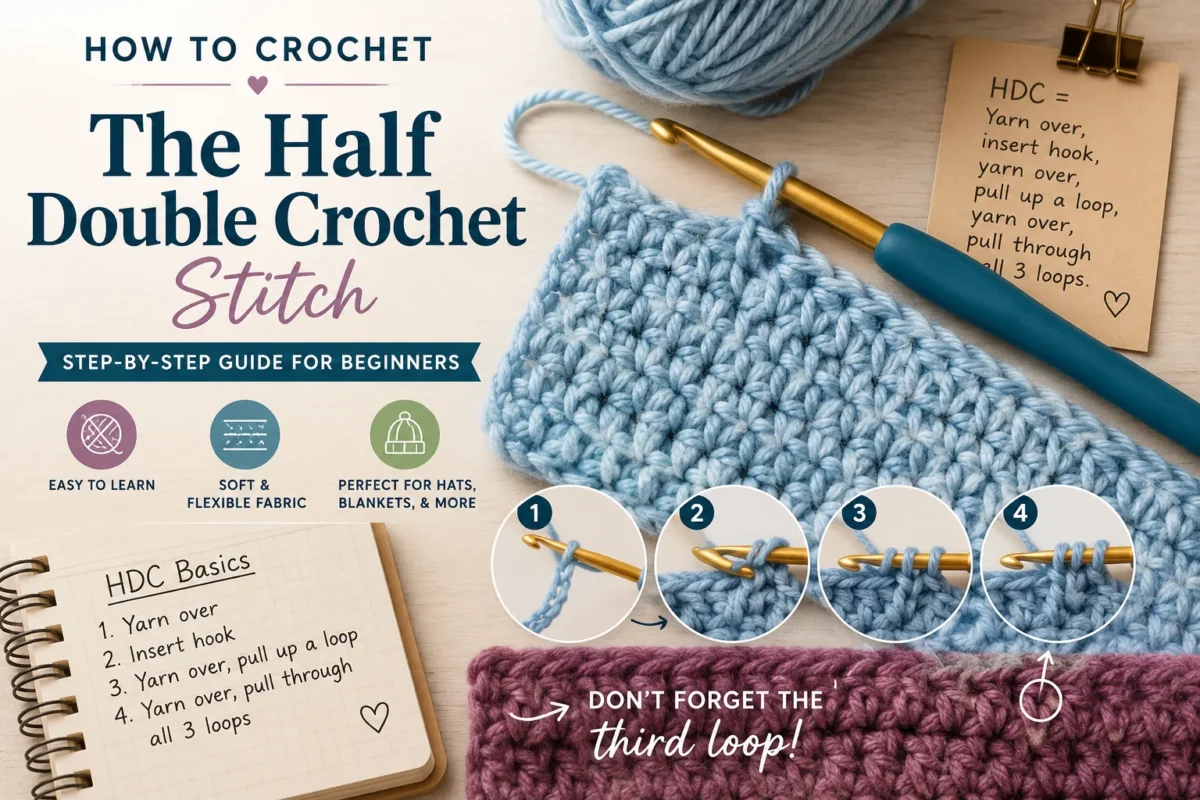
Half double crochet Stitch: A Complete Guide for Beginners and Beyond
May 22, 2026
Crochet Hook Size Chart: The Complete Guide to Hook Sizes, Conversions, and Yarn Matching
May 25, 2026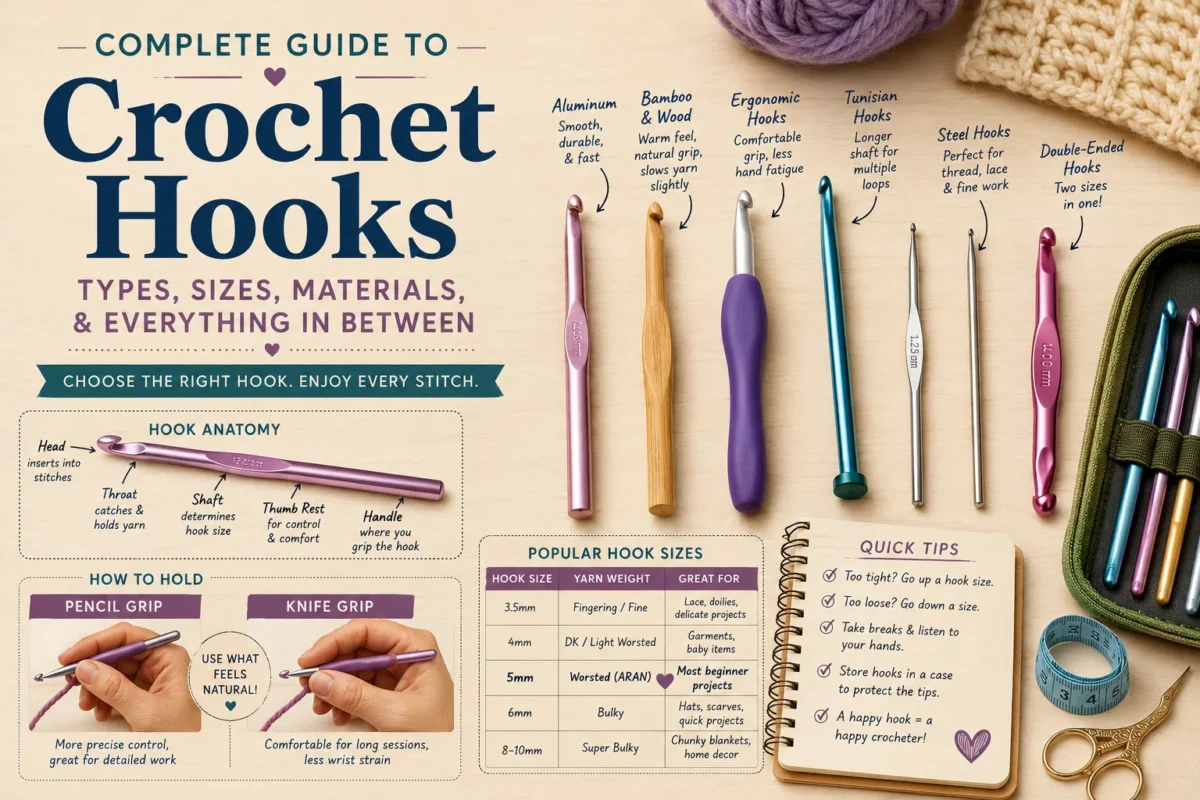
Most beginners underestimate how much the crochet hook matters. It’s easy to assume any hook will do — after all, it’s just a stick with a curved end, right? But experienced crocheters know the truth: the wrong hook can make your hands ache, throw off your gauge, and make the whole process feel frustrating when it should feel relaxing.
Choosing the right crochet hook isn’t complicated once you understand what you’re looking at. This guide walks you through every type, material, size, and feature so you can make a smart choice — whether you’re buying your very first hook or building out a full collection.
Crochet Hooks: Types, Sizes, Materials, and Everything In Between
Understanding Crochet Hook Anatomy
Before you can choose a hook, it helps to understand its parts. Every crochet hook has the same basic structure, even if the design varies:
The Head (or Tip): The pointed end that inserts into your stitches. Hooks come in inline heads (where the head is directly in line with the shaft) and tapered heads (where the tip is slightly rounded and angled). Inline hooks are often preferred for precision; tapered hooks tend to slide into stitches more easily for beginners.
The Throat: The curved section just below the head. This is what catches and holds the yarn as you pull it through stitches. A deeper throat holds yarn more securely; a shallower throat releases yarn faster.
The Shaft: The straight section between the throat and the grip. The diameter of the shaft determines the hook’s size and, therefore, your stitch size.
The Thumb Rest: A flattened area on the shaft where your thumb naturally rests. This helps you control the hook’s rotation and angle.
The Handle: The lower portion of the hook, which is what you actually grip. Some hooks have ergonomic handles; others have a simple uniform shaft all the way down.
Types of Crochet Hooks
Standard Hooks
These are your everyday, all-purpose crochet hooks. They range from tiny steel hooks used for fine thread work all the way up to massive plastic or wooden hooks for super bulky yarn. Standard hooks come in aluminum, plastic, bamboo, and wood.
Ergonomic Hooks
Ergonomic crochet hooks have cushioned, contoured handles designed to reduce hand fatigue and wrist strain. If you crochet for long sessions, have arthritis, carpal tunnel syndrome, or any kind of joint sensitivity, ergonomic hooks are worth every extra dollar.
Brands like Clover Amour, Furls, and Tulip Etimo are popular in the crochet community for their ergonomic designs. The handles are usually rubber or soft-touch material that absorbs some of the pressure from extended gripping.
Tunisian Hooks
Tunisian crochet (also called Afghan crochet) uses a completely different technique that requires a longer hook — often 30cm or more — because you hold multiple loops on the hook simultaneously, similar to knitting needles. Tunisian hooks may also have a stopper or a cable extension on the end.
Double-Ended Hooks
These hooks have a head at both ends, each a different size, making them useful for two-color Tunisian work or simply for convenience when you frequently switch between two sizes.
Steel Hooks
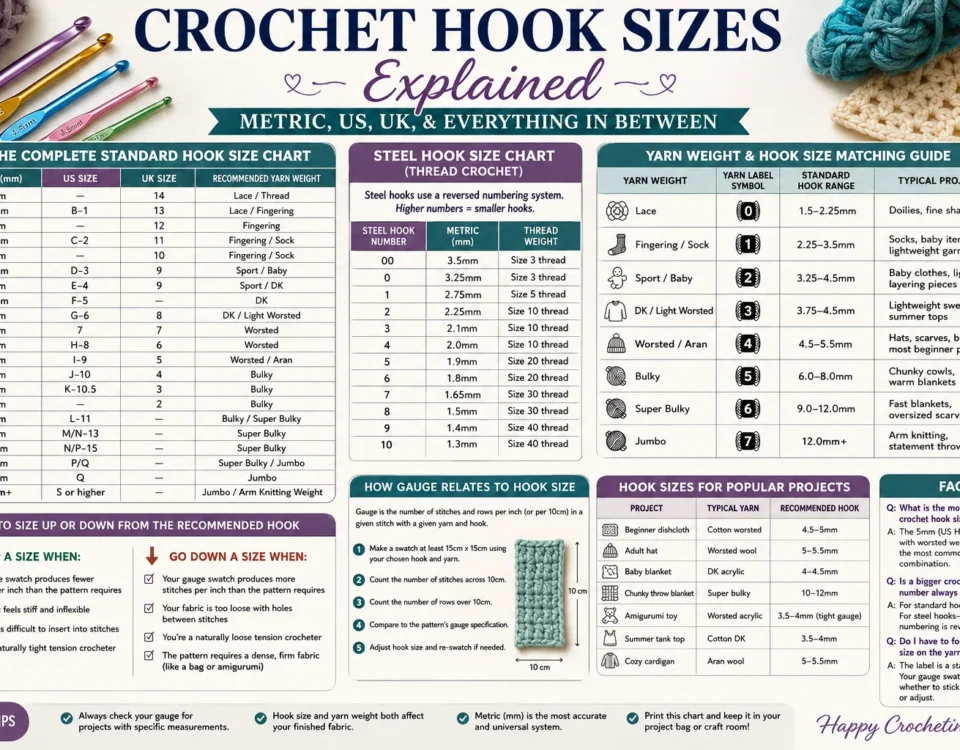
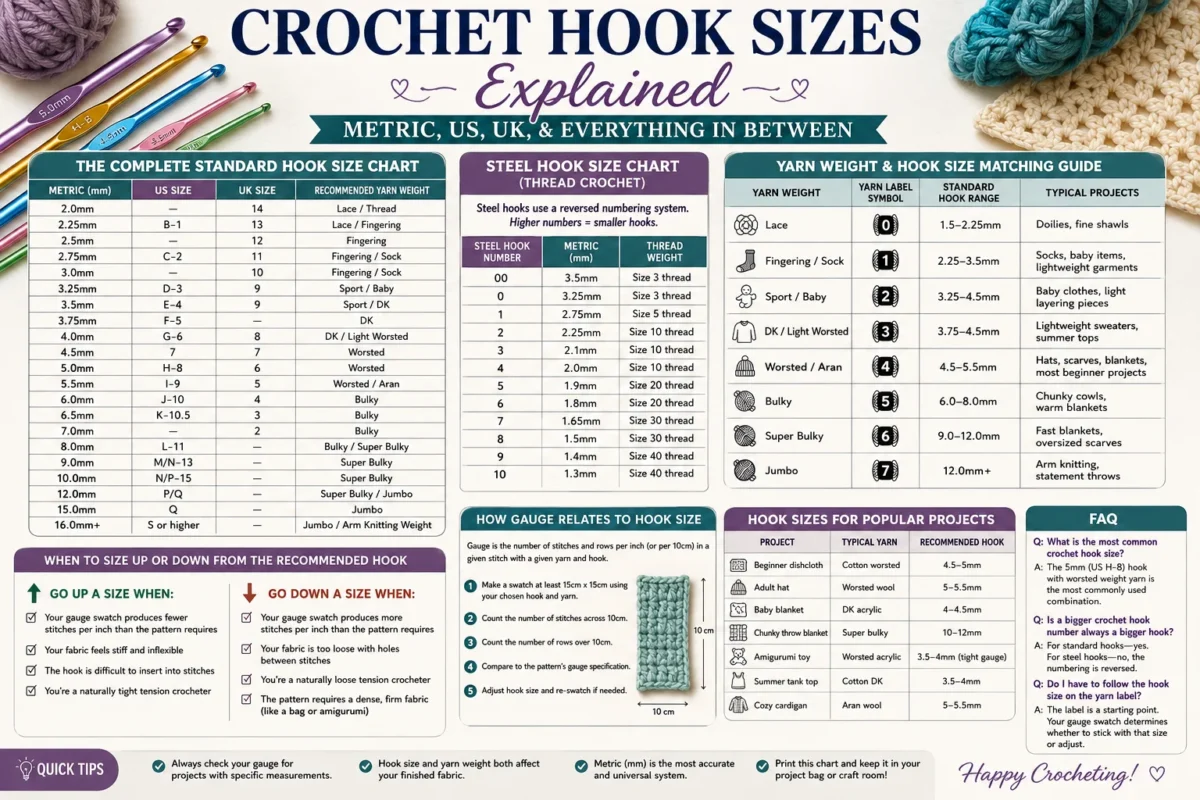
Steel hooks are small, dense, and precise. They’re used specifically for crochet thread work — doilies, lace, fine amigurumi, and decorative items. Steel hooks are numbered in reverse from standard hooks: a size 1 steel hook is actually much smaller than a standard size 1.
Crochet Hook Materials: How They Affect Your Work
Aluminum Hooks
Aluminum is the most common hook material and for good reason. Aluminum hooks are smooth, durable, lightweight, and affordable. Yarn slides off aluminum quickly, which is great for speed crocheting. They’re the reliable workhorse of most crochet hook collections.
The main downside: aluminum handles have no grip padding, so long sessions can cause hand fatigue. Many crocheters wrap the handle in craft foam or buy a set of slip-on ergonomic grips.
Bamboo and Wood Hooks
Bamboo and wooden hooks have a slightly different feel — warmer in the hand, with just a tiny bit of natural grip that slows the yarn down slightly. This actually helps some beginners who feel yarn slipping off aluminum hooks too quickly.
Bamboo hooks are lightweight and eco-friendly. They can warp or splinter if exposed to moisture repeatedly, so don’t soak them, and store them away from humidity.
High-end wood hooks made from rosewood, walnut, or birch are genuinely beautiful objects. Brands like Furls and Lantern Moon make handcrafted wooden hooks that crocheters treat as heirlooms.
Plastic Hooks
Plastic hooks are lightweight and inexpensive, which makes them a common inclusion in beginner kits. They work fine for most yarn types, though they can flex slightly under pressure with thicker yarns — not ideal for tight tension workers.
Large plastic hooks in sizes 10mm and above are often the only option since aluminum becomes heavy at those sizes.
Steel Hooks
Steel is dense, precise, and excellent for fine thread work. The smooth surface allows crochet thread to glide cleanly. Steel hooks are not interchangeable with standard yarn hooks — the sizing system is completely different.
How to Hold a Crochet Hook
There are two primary grip styles, and neither is objectively correct. Use whichever feels natural:
The Pencil Grip
Hold the hook like a pencil, with your thumb and index finger gripping the thumb rest from below and above. The hook rests in the space between your first and second knuckle. This grip tends to give more precise control.
The Knife Grip
Hold the hook like a knife, wrapping your hand over the top of the handle with your thumb resting on the flat thumb rest. This grip is often more comfortable for long sessions and puts less strain on the wrist.
Many crocheters switch between grips depending on the project or the hook style.
Signs You’re Using the Wrong Hook
Stitches are too tight to insert your hook: Your hook is too small for the yarn. Go up a size.
Stitches are loose and holes appear between them: Your hook is too large. Go down a size or tighten your tension.
Your hand cramps after 20 minutes: Consider an ergonomic hook or experiment with your grip position.
Yarn catches and splits on the hook: The hook may be damaged (a tiny burr on the tip) or the head shape isn’t suited to that yarn. Try a different hook brand.
Your gauge swatch doesn’t match the pattern: Change hook size accordingly — going up makes stitches larger, going down makes them smaller.
Caring for Your Crochet Hooks
Crochet hooks are low-maintenance tools, but a little care extends their life significantly:
- Wipe aluminum hooks with a soft cloth after use — oils from your hands can build up over time.
- Store hooks in a roll case or hook case rather than loose in a bag where tips can get dinged.
- Don’t bend or drop aluminum hooks — they can develop a slight warp that affects stitch tension.
- Keep wooden and bamboo hooks away from prolonged moisture exposure.
- Inspect the hook tip periodically for rough spots or burrs — these split yarn and damage stitches. A tiny bit of fine-grit sandpaper smooths minor imperfections on wood and bamboo.
Building Your First Hook Collection
You don’t need every size on day one. Here’s a practical starter collection:
- 3.5mm — for fine yarn and detailed work
- 4mm — DK weight projects
- 5mm — worsted weight (the most commonly used size for beginner patterns)
- 6mm — bulky yarn, fast projects
- 8mm or 10mm — super bulky, chunky blankets
As you grow in the craft, fill in the sizes between these. Most experienced crocheters eventually own the full range from 2mm to 15mm.
FAQ
What size crochet hook should a beginner start with? A 5mm hook with worsted weight yarn is the standard recommendation for beginners. It’s large enough to see your stitches clearly but small enough to produce neat, tight fabric.
What’s the difference between inline and tapered crochet hooks? Inline hooks have the throat cut directly into the shaft, creating a consistent diameter. Tapered hooks have a more rounded, angled head. Inline hooks are favored by many experienced crocheters; tapered hooks feel more forgiving for beginners.
Are expensive crochet hooks worth it? For casual crocheters, affordable aluminum hooks work perfectly well. If you crochet daily or have joint pain, investing in ergonomic hooks like Clover Amour or Furls is genuinely worthwhile.
Can I use the same hook for all yarn types? No — hook size should match your yarn weight. Using a 5mm hook with bulky yarn produces tiny, tight stitches; using a 10mm hook with fingering yarn produces loose, holey fabric.
How do I know if my crochet hook is damaged? Run the tip gently along a fingernail. If you feel any roughness, snag, or catch, the hook has a burr. On wood or bamboo, you can sand this smooth. On aluminum, it may be time to replace it.
Conclusion
The crochet hook is your primary creative tool, and understanding it properly is the foundation of enjoying this craft. Material, head shape, handle design, and size all interact to affect your finished fabric, your speed, and your physical comfort.
Start with a good quality 5mm aluminum or ergonomic hook and worsted weight yarn. As you develop your personal crochet style and tension, you’ll naturally gravitate toward the hook types that suit you best.
Invest in your tools thoughtfully — the right hook makes every project more enjoyable from the first stitch to the last.