Bag Crochet Design: How to Create Stunning Custom Bags with Unique Patterns & Styles
May 13, 2026
Crochet Tote Bag The Ultimate Guide to Making & Styling Your Perfect Handmade Tote
May 13, 2026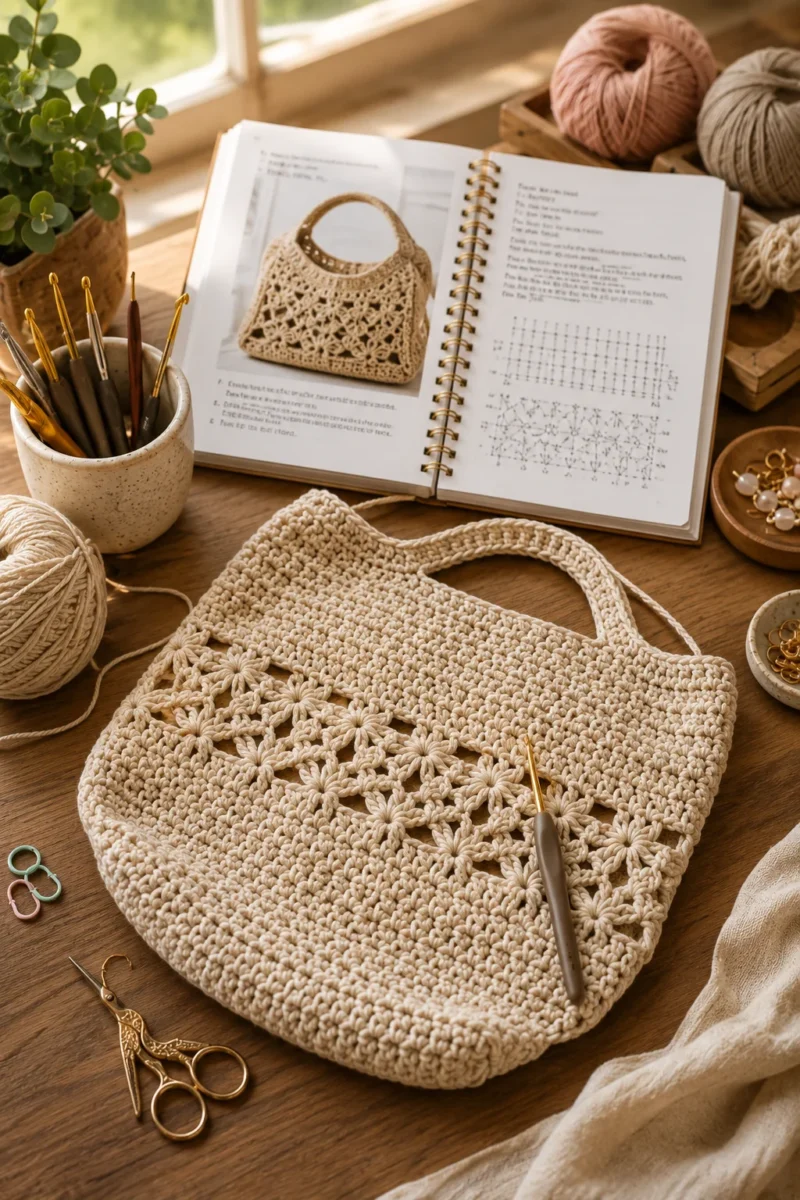
A good crochet bag pattern is like a detailed map—it guides you from a ball of yarn to a finished bag, one stitch at a time. But patterns can also feel like they’re written in code, especially when you’re learning.
Understanding how to read, evaluate, and adapt crochet patterns unlocks an entire world of projects. Instead of staring at confusing abbreviations or wondering why your bag came out twice the size it should be, you’ll approach patterns with confidence.
This guide breaks down everything you need to know about crochet bag patterns: what they contain, how to read them, where to find good ones, and how to modify them for your needs.
What Is a Crochet Bag Pattern?
A crochet bag pattern is a set of instructions that tells you exactly how to create a specific bag design. It includes stitch-by-stitch directions, material requirements, and typically some finishing instructions.
Patterns come in various formats:
- Written patterns — Text-based instructions with abbreviations
- Charts/diagrams — Visual representations using symbols
- Video tutorials — Demonstrations of each step
- Combination approaches — Written instructions with supporting charts or videos
Quality patterns include information about materials, gauge, construction techniques, and finishing. Bare-bones patterns give only stitch counts and leave you to figure out the rest.
Understanding Pattern Components
Most patterns follow a standard structure. Knowing what to expect helps you evaluate patterns before starting and find information quickly during the project.
Header Information
Pattern Name and Designer
Identifies the design and creator. Useful for searching reviews or finding other patterns by the same designer.
Skill Level
Ranges from beginner to advanced. Ratings vary between designers, so read through before assuming.
Finished Measurements
Dimensions of the completed bag. Essential for evaluating whether the pattern produces what you want.
Materials List
Yarn (weight, fiber, yardage), hook size, notions, and any additional supplies needed.
Gauge Information
Gauge tells you how many stitches and rows fit in a specific measurement (usually 4 inches) using the indicated hook and yarn. Matching gauge ensures your finished bag matches the pattern dimensions.
Special Stitches
Unique stitch combinations or techniques used in the pattern, with definitions.
Pattern Body
The actual instructions, organized by section (base, body, handles, etc.) or as continuous numbered rows/rounds.
Finishing Instructions
How to assemble pieces, weave in ends, add hardware, and complete the bag.
Decoding Crochet Abbreviations
Patterns use standardized abbreviations to keep instructions concise. Here are the most common ones you’ll encounter:
Basic Stitch Abbreviations
| Abbreviation | Meaning |
| ch | chain |
| sl st | slip stitch |
| sc | single crochet |
| hdc | half double crochet |
| dc | double crochet |
| tr | treble (triple) crochet |
| sk | skip |
| st(s) | stitch(es) |
| sp | space |
Construction Terms
| Abbreviation | Meaning |
| rnd | round |
| R | row |
| rep | repeat |
| beg | beginning |
| cont | continue |
| rem | remaining |
| tog | together |
| inc | increase |
| dec | decrease |
| PM | place marker |
| SM | slip marker |
Position and Direction
| Abbreviation | Meaning |
| BLO | back loop only |
| FLO | front loop only |
| FP | front post |
| BP | back post |
| RS | right side |
| WS | wrong side |
Punctuation Meaning
- Parentheses ( ) — Indicates a group of stitches worked in the same stitch or space, or instructions to repeat
- Brackets [ ] — Often used for size variations or to group repeated instructions
- **Asterisks * ** — Marks the beginning of a sequence to repeat
How to Choose the Right Pattern for Your Skill Level
Patterns are typically rated beginner, easy, intermediate, and advanced. But what do these actually mean?
Beginner Patterns
- Use basic stitches only (chain, single crochet, sometimes double crochet)
- Simple construction, often worked flat or in basic rounds
- Minimal shaping or assembly
- Clear, detailed instructions with few assumptions
Easy Patterns
- May include a wider range of basic stitches
- Simple stitch patterns or textures
- Straightforward assembly
- Some previous crochet experience assumed
Intermediate Patterns
- Multiple stitch techniques combined
- Shaping involved (increases, decreases, working sections separately)
- More complex construction
- Hardware integration or lining instructions
Advanced Patterns
- Complex stitch patterns
- Intricate construction methods
- Advanced techniques (colorwork, structural shaping, unusual constructions)
- Assumes strong foundational skills
Evaluating Patterns Before You Start
Beyond skill level labels, look for:
- Clear photography showing construction details, not just beauty shots
- Stitch counts at the end of rows/rounds (helps catch mistakes early)
- Written special stitch definitions for anything unusual
- Reviews from other crafters mentioning issues or corrections
- Pattern support (designer’s willingness to answer questions)
Reading Written Patterns vs Charts
Patterns present information in two main formats. Understanding both expands your pattern options.
Written Patterns
Text-based instructions using abbreviations and descriptive language.
Example:
Rnd 1: Ch 2, 6 sc in 2nd ch from hook, sl st to first sc to join. (6 sc)
Rnd 2: Ch 1, 2 sc in each st around, sl st to join. (12 sc)
Advantages:
- Explicit about what to do
- Easy to annotate with your own notes
- Works well for complex instructions
Challenges:
- Can be dense to read
- Requires memorizing abbreviations
- Harder to visualize the overall pattern
Charted Patterns
Visual diagrams using symbols for each stitch.
Advantages:
- Shows structure visually
- Easy to see pattern repeats
- Universal (symbols are international)
- Helpful for colorwork planning
Challenges:
- Requires learning symbol meanings
- Can be cluttered for complex patterns
- Some find them harder to follow than text
Combining Both
The best patterns offer written instructions with supporting charts. You can reference whichever works better for each section.
The Importance of Gauge
Gauge determines whether your finished bag matches the pattern’s dimensions. Many crafters skip gauge swatches—and many projects come out wrong as a result.
Why Gauge Matters for Bags
- Size accuracy — A bag that’s supposed to hold a laptop shouldn’t end up clutch-sized
- Fabric density — Too loose, and items fall through or the fabric stretches; too tight, and the bag is stiff
- Yarn consumption — Wrong gauge affects how much yarn you need
How to Make a Gauge Swatch
- Using the pattern’s recommended yarn and hook size, crochet a sample at least 6″ x 6″
- Block the swatch as you would the finished item
- Measure 4″ in both directions and count stitches and rows
Adjusting Gauge
If your swatch doesn’t match:
- Too many stitches per inch → Use a larger hook
- Too few stitches per inch → Use a smaller hook
Keep testing until you match or decide to accept size variation.
Yarn Substitution Guide
Want to use a different yarn than the pattern specifies? Here’s how to substitute successfully.
Match These Factors
Yarn Weight
Most important factor. Substitute within the same weight category (DK for DK, worsted for worsted). The Craft Yarn Council weight system (0-7) standardizes categories.
Fiber Content
Different fibers behave differently. Cotton holds shape; acrylic stretches. Wool has memory; linen relaxes. For bags, prioritize non-stretchy fibers.
Yardage
Calculate total yards needed, not just number of skeins. Different brands have different put-ups.
Texture
Smooth yarn shows stitch definition; textured yarn obscures it. Consider whether the pattern relies on visible stitch patterns.
Substitution Steps
- Identify the original yarn’s weight and fiber
- Choose a substitute with the same weight
- Consider fiber properties for the project type
- Calculate yardage needed
- Make a gauge swatch with the substitute
- Adjust hook size if needed
Modifying Patterns for Custom Sizes
Sometimes a pattern produces a bag that’s almost right—just not the exact size you want.
Scaling Width
For bags worked in rows:
- Calculate stitches per inch from your gauge
- Multiply by desired width
- Adjust starting chain accordingly
For bags worked in the round:
- Change the number of stitches in the base round
- Adjust increase rounds proportionally
Scaling Height
Simply add or subtract rows/rounds to the body section. For shaped bags, maintain the pattern’s ratio of increases to straight sections.
Scaling Both Dimensions
This gets more complex. You’re essentially redesigning proportions. Consider:
- Base proportions (length to width ratio)
- How increases will work at the new scale
- Whether stitch patterns will repeat correctly at the new size
Keeping Records
Document every modification. Note your changes, yarn used, hook size, and final measurements. This turns your modified version into a custom pattern you can replicate.
Common Pattern Mistakes and How to Avoid Them
Skipping the Read-Through
Read the entire pattern before starting. Surprises mid-project waste time and materials.
Ignoring the Gauge Swatch
See the earlier section. This step prevents disappointment.
Miscounting Stitches
Use stitch markers liberally. Count at the end of rows/rounds, especially early on.
Not Checking for Errata
Patterns sometimes have errors. Check the designer’s website or Ravelry for corrections before starting.
Assuming “Easy” Means “Foolproof”
Even simple patterns require attention. Don’t assume you can auto-pilot through.
Working in Poor Lighting
You need to see what you’re doing. Proper lighting reduces mistakes and eye strain.
Where to Find Quality Crochet Bag Patterns
Free Patterns
Blogs and Websites
Individual designers and craft sites offer free patterns, often with ads or in exchange for newsletter signups.
Ravelry
The largest pattern database. Filter by free, project type, and difficulty. User reviews help evaluate quality.
YouTube
Video tutorials for visual learners. Search by bag style.
Pinterest
Aggregates patterns from across the web. Follow links to original sources.
Paid Patterns
Individual Designers
Purchase directly through designer websites or storefronts. Often includes additional support.
Ravelry
Paid patterns alongside free ones. Easy purchasing and storage.
Etsy
PDF patterns from independent designers. Read reviews before buying.
Pattern Membership Sites
Subscription access to pattern libraries. Good value if you crochet frequently.
Evaluating Pattern Quality
Look for:
- Clear, well-lit photos from multiple angles
- Stitch counts included
- Reviews from other makers
- Designer responsiveness to questions
- Professional formatting and editing
Building Your Pattern Library
As you collect patterns, organize them for easy access:
Digital Organization
- Create folders by category (bags, garments, home items)
- Include project photos when you complete patterns
- Note yarn substitutions and modifications you made
- Rate patterns for future reference
Physical Organization
- Use a binder with sheet protectors for printed patterns
- Add your notes directly to copies
- Keep completed project photos with patterns
- Organize by skill level or project type
Pattern Notes
After completing a project, record:
- What worked well
- What you’d change next time
- Yarn used and yardage needed
- Final measurements
- Hook size adjustments
FAQ
What does “fasten off” mean in a crochet pattern?
Fasten off means to cut the yarn and pull the tail through the final loop to secure it. This completes a section or the entire project.
What’s the difference between US and UK crochet terms?
The same words mean different stitches. US single crochet equals UK double crochet. US double crochet equals UK treble. Always identify which terminology the pattern uses.
How do I know if I have enough yarn to finish a pattern?
Calculate total yardage needed and compare to what you have. If unsure, weigh your completed work and remaining yarn—you can estimate whether you’ll run short.
Can I sell items made from someone else’s pattern?
Check the pattern’s license. Many designers allow commercial use; others prohibit it. When in doubt, contact the designer.
What should I do if I find an error in a pattern?
Contact the designer—they’ll appreciate knowing about issues. Check online for errata that may already address the problem.
How do I keep my place in a long pattern?
Print the pattern and use a highlighter or sticky notes. In digital versions, use annotation features. Some crafters use row counters or apps to track progress.
Conclusion
Mastering crochet bag patterns gives you access to countless designs—from simple market bags to elaborate structured handbags. The skills transfer across all types of crochet projects, making you a more confident and capable maker.
Start with patterns that match your skill level, always swatch for gauge, and don’t hesitate to modify patterns to fit your vision. Every pattern you complete teaches something new, and your library of completed projects becomes a record of your growing abilities.
Choose a pattern that excites you, gather your materials, and start crocheting. That handmade bag is waiting to be made.